

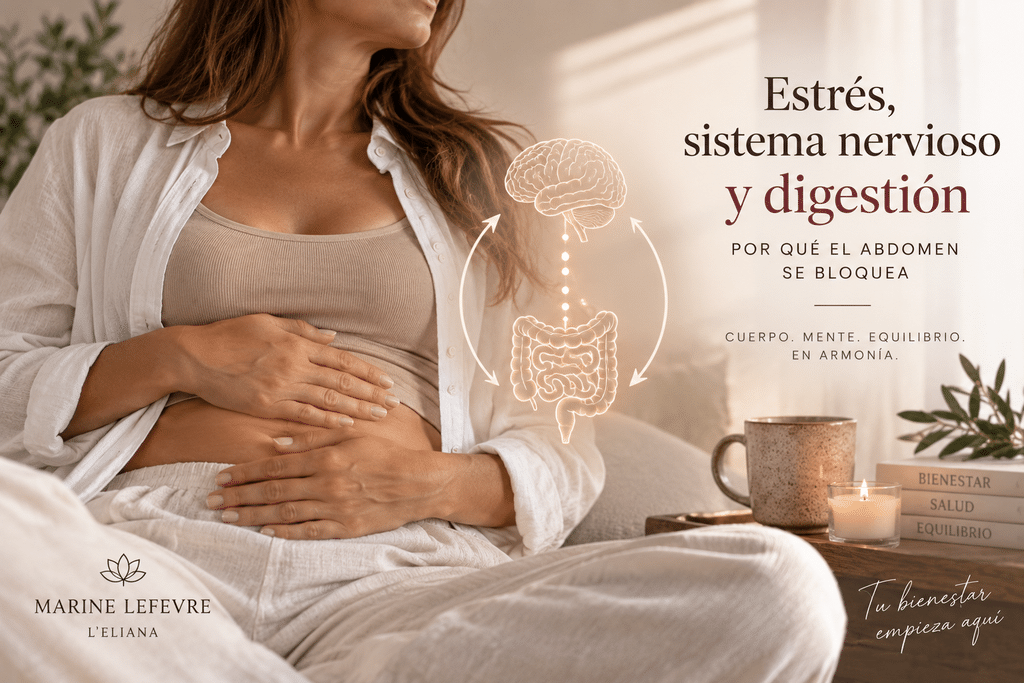
Stress, nervous system and digestion: why the abdomen gets blocked
Have you noticed that your abdomen swells just in the weeks when you have more work, you sleep worse, or you feel like you can’t stop? Do you eat practically the same thing, but suddenly you experience heaviness, gas, slow digestion, or constipation?
The stress and digestion They are much more related than it seems.
When we talk about “the abdomen locking up,” we don’t mean that there is literally an intestinal blockage. It’s a simple way of describing a very common feeling: a rigid belly, pressure, bloating, shallow breathing, difficulty relaxing, and a digestive system that doesn’t seem to function with the same fluidity as it used to.
The digestive system and the nervous system maintain constant communication.
That’s why a worry can be felt in the stomach, a nervous situation can speed up the intestines, and a prolonged stage of stress can coincide with changes in digestion.
Understanding this connection helps us stop focusing solely on what we eat and start observing how we live, breathe, rest, and manage daily stress.
Stress and digestion: a real connection between the brain and the intestines
The brain and the digestive system do not function as two completely separate systems.
They communicate in a bidirectional way through a complex network of nerve, hormonal, and immune signals that is often known as gut-brain axis.
The enteric nervous system, an extensive network of neurons located in the gastrointestinal tract, is involved in this communication.
The autonomic nervous system, the vagus nerve, certain hormones, and the intestinal microbiome itself are also involved.
This explains why our emotions can have such clear physical manifestations.
Before an important interview we may feel butterflies in our stomachs.
When bad news arrives, some people completely lose their appetite.
Others feel an urgent need to go to the bathroom.
And during prolonged periods of tension, more uncomfortable digestive problems, constipation, or a feeling of a swollen abdomen may appear.
That does not mean that the symptoms are imaginary.
The connection between the gut and the brain It is physiological and can influence motility, digestion, sensitivity and pain perception.
What happens in the body when we are stressed?
Stress is a natural response of the body.
When the brain interprets that there is a threat, a requirement, or a situation that requires a quick reaction, it activates mechanisms designed to help us respond.
The problem is not feeling stress on a one-off basis.
The difficulty arises when the body remains in a state of alert for too long:
- work,
- family responsibilities,
- lack of rest,
- personal problems,
- economic concerns,
- excessive activity,
- A permanent feeling of having to get everything done.
In these situations, the body can remain prepared to act even when we are sitting in front of the computer or trying to sleep.
Breathing can become faster and shallower, muscle tension increases and we may lose part of our ability to perceive body signals calmly.
And the abdomen is also involved in this response.
Nervous system and digestion: why the gut can change its rhythm
The autonomic nervous system regulates many functions that we perform without consciously thinking about them.
Among them are part of the digestive activity and gastrointestinal motility.
That is why a stressful situation can alter the intestinal rhythm.
In some people the transit speeds up.
They may appear:
- intestinal urgency,
- more frequent bowel movements,
- feeling of a churning stomach,
- abdominals pains,
- diarrhea.
In others, the exact opposite happens:
- slow digestion,
- constipation,
- weightiness,
- sense of fullness,
- difficulty in expelling gas.
There is no single answer to stress.
Two people subjected to a similar situation may experience completely different digestive symptoms.
Even the same person can react differently depending on the moment in their life.
Why do we feel the abdomen “blocked” when we are under pressure?
The feeling of Abdomen blocked by stress It is usually the result of several factors that can appear simultaneously.
We breathe more superficially
When we are tense, we tend to breathe more with the upper part of the thorax.
Diaphragmatic breathing can become less wide and we may feel that the entire abdominal area remains rigid.
The diaphragm is a fundamental muscle of breathing that lies between the thorax and the abdomen.
Its movement accompanies every inspiration and breath.
When we breathe for short periods of time for many hours, we can also notice increased tension in the ribs, chest, back, and abdomen.
Taking a few minutes to breathe slowly does not “cure” a digestive problem.
But it can be part of a routine designed to reduce the overall feeling of arousal and tension.
We contract the abdomen without realizing it
Many people keep their stomach contracted for much of the day.
Sometimes it happens due to stress.
Other times it is a habit related to posture or to trying to keep the belly permanently inwards.
This continuous contraction can cause a feeling of stiffness.
Take a test.
Without forcing anything, observe right now:
- your jaw,
- your shoulders,
- Your abdomen.
Are they really relaxed?
Many times we discover that we have been pressing on one of these areas for hours without being aware of it.
We eat faster
Stress acts not only directly on the body.
It also changes our behaviors.
When we are in a hurry we can:
- eating standing up,
- eating in front of the computer,
- looking at the phone during a meal,
- chewing less,
- Ending too quickly.
When we eat quickly, we can also swallow more air.
That air can contribute to the feeling of gas, pressure, and abdominal distention.
That's why sometimes the problem isn't just What we have eaten, but also How we have done it.
The intestinal transit can be modified
Communication between the brain and the gut influences gastrointestinal motility.
That is, in the movements that allow food and waste to move through the digestive tract.
During stress, this motility can change.
For some people it means acceleration.
For others, a slowdown.
When traffic becomes slower and congestion appears, the feeling of a full or swollen abdomen can also increase.
We can perceive the digestive sensations more intensely
Stress can also influence our body sensitivity.
When the nervous system is constantly alert, certain sensations can be perceived more intensely.
This does not mean that “everything is in the head”.
So-called gut-brain interaction disorders can cause real symptoms such as pain, bloating, constipation or diarrhea, even when conventional tests do not show an obvious structural injury.
The stress-swelling-stress cycle
There is also a particularly frustrating phenomenon.
Stress can coincide with more digestive discomfort and, at the same time, digestive discomfort can increase stress.
Imagine this situation.
You get up with your abdomen comfortable.
After an intense morning, you eat quickly.
In the afternoon you notice pressure and gases.
You start to notice the belly.
You're worried that it will swell up again.
Decides to control what you eat even more.
That surveillance generates more tension.
A circle may appear like this:
stress → digestive changes → swelling → worry → more tension → increased perception of the swelling
Breaking this cycle does not consist of ignoring the symptoms.
It consists of approaching them from several angles:
- food,
- intestinal transit,
- rest,
- breathing,
- physical activity,
- stress,
- medical evaluation when necessary.
Stress, gas and swollen abdomen
Gases are a normal part of digestion.
However, certain circumstances can make us notice them even more.
Eating quickly, drinking carbonated beverages, chewing gum frequently, and talking a lot during meals or swallowing more air can all contribute to increasing the feeling of gas.
Fermentation of certain foods in the intestine also plays a role.
But having gas during a stressful phase doesn't automatically mean that you have developed an intolerance.
Before eliminating multiple foods, it is advisable to observe if there is a clear pattern.
Ask yourself:
Does it always happen with the same food?
Or does it appear especially on days when I’m tired, like when I’m driving at full speed and have been under pressure for several hours?
This difference can provide useful information.
Stress and constipation
For some people, one of the main manifestations of a stage of stress is constipation.
The schedules change.
The urge to go to the bathroom is ignored.
It reduces daily movement.
The feeding becomes irregular.
And the intestinal rhythm itself can be modified.
When the traffic is slower, it is common to notice a greater sense of fullness or relaxation.
That is why, when faced with a swollen belly, it is worth asking yourself a simple question:
How is my intestinal transit actually functioning?
Observe whether:
- you go to the bathroom less than before,
- it takes a lot of effort,
- the feces are especially hard,
- There is a feeling of incomplete evacuation.
Stress does not explain all digestive problems
Relate stress and digestion It does not mean attributing any abdominal symptoms to the nervous system.
This point is fundamental.
Swelling, pain, bowel changes, or a feeling of slow digestion can have many different causes.
Therefore, if the symptoms are new, persistent, intense, or worsen, it is important to talk to a healthcare professional.
We should not use stress as an automatic explanation for everything.
We should also not assume that a problem is “emotional” simply because certain tests are normal.
Currently, the existence of gut-brain interaction disorders is recognized, in which persistent gastrointestinal symptoms appear related to alterations in the way the brain and gut communicate.
What you can observe when your abdomen gets blocked
Before trying to change everything, for a few days you can observe five aspects.
How you breathe
Does your breathing comfortably reach the abdominal area?
Or does it always remain in the upper part of the chest?
How you eat
Are you sitting down?
Chewing?
Do you eat in ten minutes while you answer messages?
How is your transit?
Has the frequency of going to the bathroom changed?
When swelling appears
Do you get up swollen?
Or does it increase progressively as the day progresses?
How is your stress level?
Do the days of higher pressure coincide with more discomfort?
You don't need to obsessively analyze every meal.
The goal is simply to detect patterns.
How to help the body get out of the alert mode
When the digestive symptoms are mild and there is no illness requiring specific treatment, some habits can help reduce the overall stress load.
Create a pause before eating
You don't need to perform a long meditation.
Sometimes it’s enough to sit down, put the phone away for a few minutes, and take several slow breaths before starting.
The goal is to stop switching directly from a stressful task to eating quickly.
Chewing and reducing speed
Eating more slowly may seem like an overly basic piece of advice.
But it can completely change the experience of a meal.
It allows you to better recognize when you’re full and prevents each meal from becoming another activity done in a rush.
Walking
A gentle walk can be a simple tool for changing the pace, moving, and clearing the mind.
It should not be seen as a way to compensate for what you have eaten.
The movement is part of the general well-being.
Recovering a freer breathing
Place one hand on the chest and the other on the abdomen.
Breathe without trying to overinflate the belly.
Simply observe if, little by little, you can allow the ribs and the abdomen to accompany the breathing.
You can use this practice as a transition between an intense day and a moment of rest.
Check the jaw, shoulders, and abdomen
These three zones usually offer a lot of clues about our level of stress.
Several times a day you might ask yourself:
Am I pressing something that could release itself?
There is no need to force it.
It is simply a matter of regaining body awareness.
What role can massage play when stress accumulates?
A wellness massage does not replace a medical evaluation or treat a digestive illness.
Its function is different.
When you maintain a high pace for days or weeks, many people seek massage precisely because it is difficult for them to stop on their own.
During a session, the body receives a different context:
- less stimuli,
- less haste,
- a space dedicated to feeling,
- a time reserved for relaxing.
In Marine Lefevre, in Eliana, Valencia, The sessions are adapted to each person's feelings.
If stress, back strain, neck stiffness, or a feeling of being unable to disconnect dominate, Marine can adapt the pace and pressure of its massage to suit your needs. massages in L’Eliana.
It is not about claiming that a massage will “unblock the intestine”.
It is about working on body well-being, relaxation, and the tensions that can accompany many stages of overload.
Traditional Chinese Medicine, Tui Na and stress
Marine's approach also includes techniques inspired by Traditional Chinese medicine in L’Eliana, such as the Tui Na massage.
Tui Na uses pressures, movements and rhythmic movements adapted to each person.
During a session, Marine can work on different areas of the body, taking into account where the sensation of tension is concentrated and what intensity feels comfortable.
For someone who has been carrying heavy loads for weeks with their shoulders high, a stiff back and a constant feeling of acceleration, taking time to slow down can be part of a comprehensive self-care routine.
It is important to maintain a clear distinction.
These treatments are offered as wellness and relaxation practices.
They do not replace the diagnosis or medical treatment of a gastrointestinal pathology.
The abdomen can also reflect how you are living.
Sometimes we focus so much on achieving a flat stomach that we stop asking how we feel.
We observe the belly.
We hide it.
We contract it.
We changed our food.
We are looking for supplements.
But we don't always look at the full context.
Maybe we've been sleeping very little for several weeks now.
Perhaps we all eat in front of a screen every day.
Maybe we don't really pause from the moment we wake up until the moment we go to bed.
Perhaps we breathe superficially and keep our abdomens contracted for hours.
None of this means that all digestive symptoms are caused by stress.
It means that the nervous system is also part of the body and deserves to be included in the conversation.
When to consult for digestive symptoms
It is advisable to consult a healthcare professional when symptoms persist, appear in new ways, or significantly affect daily life.
There are also symptoms that require special attention, such as:
- unintentional weight loss,
- blood in the stool,
- persistent vomiting,
- fever,
- severe abdominal pain,
- difficulty swallowing,
- black feces,
- the abdomen becoming increasingly relaxed without a clear explanation.
The NIDDK also recommends medical evaluation for persistent digestive symptoms or those accompanied by certain warning signs.
In the face of significant or progressive symptoms, the goal should not simply be to “relax more”; rather, it should be to seek appropriate evaluation.
Stress and digestion after 40
Starting at age 40, several changes can coincide.
For some women, perimenopause begins.
Changes in sleep patterns, hormonal changes, and a greater sense of fatigue can occur.
At the same time, professional and family responsibilities can be at their most intense.
If the rest gets worse and stress increases, it can also be more difficult to manage digestive discomfort.
In addition, abdominal swelling can have digestive, hormonal, and lifestyle-related causes.
That is why it is important to avoid explanations that are too simple.
Not all swollen bellies are fat.
Not all swelling is hormonal.
And not all digestive symptoms are caused by stress.
If you are interested in this topic, you can also read our article about menopause and abdominal inflammation.
A more gentle approach towards the abdomen
Instead of thinking:
“My stomach hurts.”.
We can slightly change the question:
What is my body needing today?
Maybe he needs to eat more calmly.
Maybe he needs movement.
Maybe he needs to sleep.
Perhaps he needs a medical evaluation.
Perhaps he needs to stop being permanently contracted.
Or maybe he just needs an hour without any demands.
This change of perspective is not intended to turn self-care into another obligation.
It seeks to regain the ability to listen to the body before automatically reacting against it.
Well-being and relaxation in L’Eliana, Valencia
If you notice that you are going through an overload phase and your body is accumulating tension, you can discover the wellness treatments available. Marine Lefevre in L’Eliana, near Valencia.
The sessions adapt to how you arrive that day:
- tension in the back and neck,
- fatigue,
- feeling of heaviness,
- the need to disconnect,
- accumulated stress.
You can also discover the sessions inspired by the Traditional Chinese medicine in L’Eliana, where Marine uses techniques such as Tui Na and adapts the rhythm, movements, and pressure to your sensations.
The goal is not to treat a digestive pathology.
It is offering a space where you can slow down, listen to your body, and regain a sense of well-being.
Frequently asked questions about stress, the nervous system, and digestion
Can stress cause abdominal swelling?
Stress can influence intestinal motility, digestive sensitivity, and our daily habits.
That is why some people notice more bloating, gas, diarrhea, or constipation during periods of stress.
However, persistent swelling should be evaluated to rule out other causes.
Why do I feel a hard abdomen when I am nervous?
There can be a combination of muscle tension, more superficial breathing, gas formation, or digestive distension.
Many people involuntarily contract the abdomen when they are stressed.
Can stress cause constipation?
It can contribute in some people.
Stress can coincide with changes in the intestinal rhythm and, in addition, modify habits related to eating, movement, rest, and visits to the bathroom.
Why does stress sometimes cause diarrhea and other times constipation?
The digestive response to stress is not identical for everyone.
In some people the transit can speed up and in others it can slow down.
Different symptoms can also appear at different times.
Can breathing better help digestion?
Breathing techniques can help reduce the overall feeling of activation and tension, although they do not replace the treatment of a digestive disorder.
They can be integrated as a simple relaxation tool.
Can a massage remove the swelling caused by stress?
A wellness massage can promote relaxation and help reduce the feeling of body tension.
But it should not be presented as a treatment for a digestive disease or as a universal solution for bloating.
If the problem persists, it is advisable to consult a doctor.
When should I be concerned about swelling?
When it is persistent, it worsens, appears suddenly, or is accompanied by symptoms such as intense pain, vomiting, fever, bleeding, involuntary weight loss, or significant changes in bowel function.
Your body does not separate stress from the physical
Stress does not live solely in thoughts.
You can feel it in:
- the jaw,
- the shoulders,
- the back,
- the breathing,
- the abdomen.
The connection between nervous system and digestion It helps to understand why some stages of our life seem to settle directly in the womb.
That’s why, when you feel that your abdomen is “blocked,” try not to reduce the whole situation to a specific meal or a purely aesthetic issue.
Observe the whole.
Your rest.
Your rhythm.
Your breathing.
Your intestinal transit.
Your diet.
And also your level of tension.
If you need a space to slow down, release the body’s load, and reconnect with yourself, you can rBook a treatment in L’Eliana with Marine Lefevre and choose a session tailored to what you are feeling at the moment.